Clinical problem
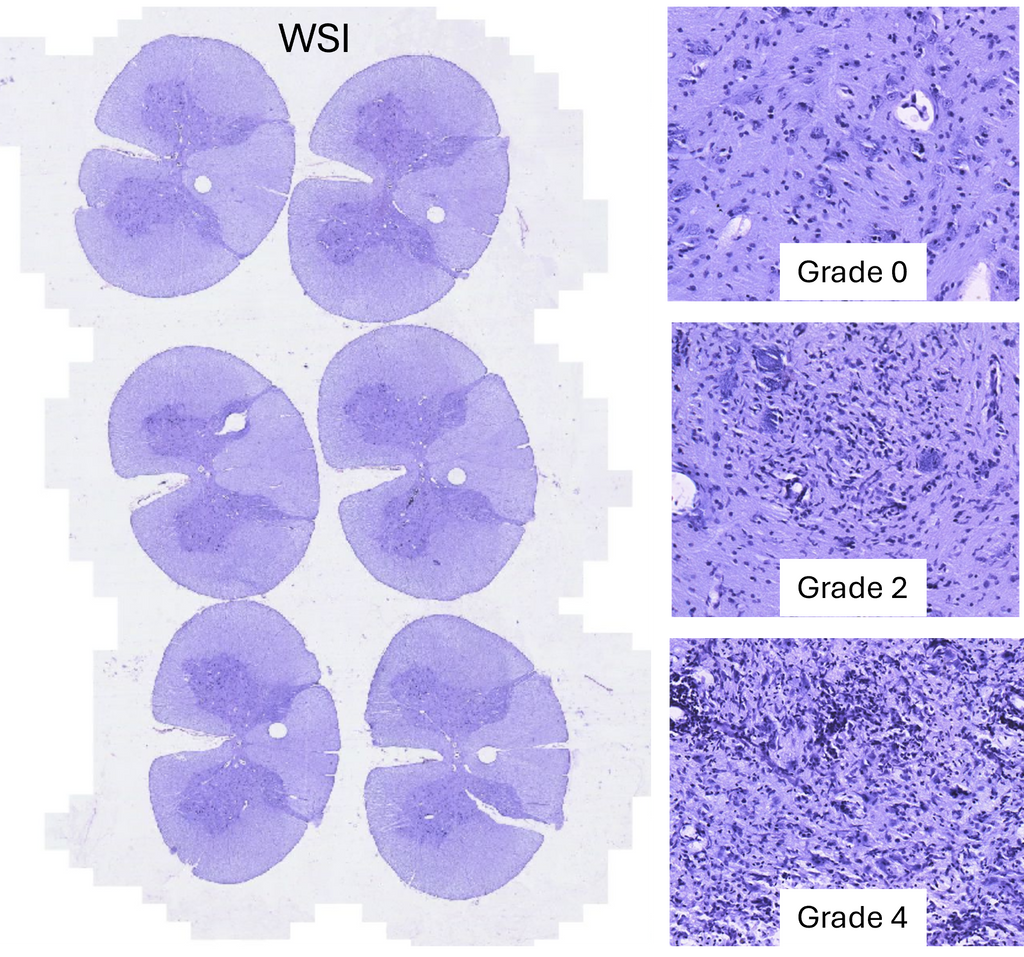
The Monkey Neurovirulence Test (MNVT) is used to assess the risk of virulence of the oral polio vaccine by scoring the severity of lesions found in brain and spinal cord tissue sections. The scoring is performed using a grading system which establishes lesion severity in a scale of 0 to 4. Currently, two different pathologists visually assess multiple sections of tissue and need to agree on a score which indicates the safety of the corresponding vaccine batch. This can be challenging as lesion identification and grading can be subjective, affecting inter-reader consistency and reproducibility. In this project we aim to develop a weakly supervised model that predicts a score directly from tissue sections, providing pathologists with a decision-support tool to improve their workflow.
Goals
Primary goal: develop a weakly supervised learning model for scoring of MNVT tissue sections.
Further goals:
- Establishing preprocessing and data curation pipeline for the histopathology slides
- Validation of model performance and generalizability across different tissue sections and batches
- Evaluation of model scalability as the dataset grows
Data
A dataset of more than 1000 histopathology slides is available for training and validation of the model. The dataset spans 10 distinct anatomical regions of the brain and spinal cord. The industry partner performs the MNVT as part of their vaccine quality control pipeline.
Requirements
- Students with a major in computer science, biomedical engineering, artificial intelligence, physics, or a related area in the final stage of master level studies are invited to apply.
- Affinity with programming in Python and familiar with the deep learning libraries.
- Interest in deep learning and medical image analysis.
Information
- Project duration: 6-9 months, ideally able to start before end of April
- Location: Radboud University Medical Center
- You will be part of the Diagnostic Image Analysis Group (DIAG) and Computational Pathology Group, whose research focus is the analysis of histopathological slides with deep learning techniques.
- You will have access to and work with a large GPU cluster.
- Note that per our union rules, Radboudumc is unable to provide compensation for Master’s thesis projects. Relatedly, we are also unfortunately unable to sponsor those that require a visa for the Netherlands for Master’s thesis projects.
- For more information please contact Maria Ferrandez (mariacristina.ferrandez@radboudumc.nl).